

Atlanta Distracted Driving Accident Attorney — We Fight for Victims Like You
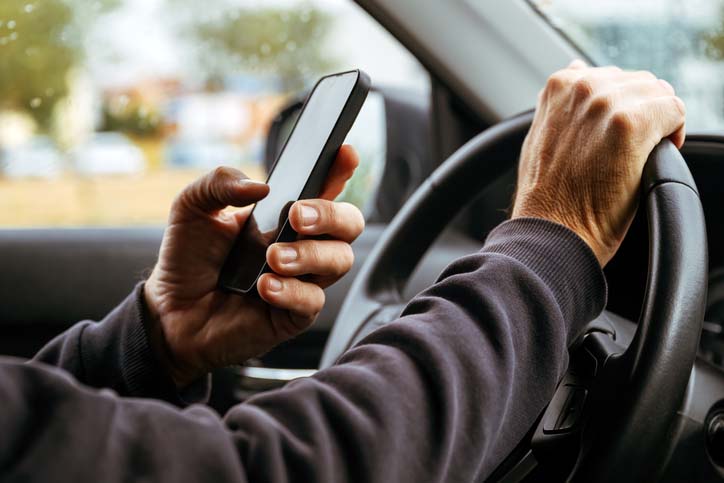
Few decisions behind the wheel are as recklessly selfish as choosing to look at a smartphone, respond to a text, or engage with an in-dash screen while navigating Atlanta traffic. When a motorist takes their eyes or mind off the road, a routine commute on I-85, I-285, or Downtown Connector can turn catastrophic in a fraction of a second.
If you or a loved one were hurt by an inattentive driver, you are facing a long road of physical recovery and financial stress. While a standard Atlanta car accident claim focuses on general driver negligence, collisions caused by distracted driving center on specific statutory violations and require immediate digital evidence preservation to prove liability.
At Mabra Law, our Atlanta distracted driving accident attorneys subpoena cell phone records, extract event data recorder (black box) telemetry, and leverage Georgia’s Hands-Free Law to hold reckless drivers fully accountable.
Georgia’s Hands-Free Law (O.C.G.A. § 40-6-241) & Negligence Per Se
In 2018, state lawmakers enacted the Hands-Free Georgia Act (O.C.G.A. § 40-6-241) to curb mobile device diversions on public roads. Under Georgia law, drivers are strictly prohibited from performing any of the following actions while operating a motor vehicle:
- Physical Device Contact: Physically holding or supporting a wireless telecommunications device or stand-alone electronic device with any part of their body.
- Text-Based Communication: Writing, sending, or reading text messages, instant messages, emails, or internet data while behind the wheel.
- Video Consumption & Recording: Watching video or movie content on a mobile device, or recording video while driving (excluding continuous dashcam systems).
- Headphone Restrictions: Wearing headphones or earbuds for non-communication purposes while driving.
Establishing Negligence Per Se: When a driver violates O.C.G.A. § 40-6-241 and causes a crash, their breach of statute constitutes negligence per se. This means legal fault is established as a matter of law, eliminating the driver’s ability to claim the crash was an unavoidable accident.
Proving Distraction: Cell Record Subpoenas & Digital Forensics
At-fault drivers almost never admit to law enforcement that they were texting or checking social media prior to a crash. Because insurance companies will aggressively dispute liability without direct proof, Mabra Law executes a digital forensic investigation to establish driver distraction:
- Cellular Carrier Subpoenas: Issuing formal legal subpoenas to wireless providers (Verizon, AT&T, T-Mobile) to secure detailed call logs, incoming/outgoing text timestamps, and cellular data packet transmissions matching the exact second of the impact.
- Spoliation Letters: Dispatching immediate legal demand letters to the at-fault driver and their insurance carrier prohibiting the destruction, deletion, or resetting of mobile devices, cloud backups, or social media activity logs.
- Event Data Recorder (EDR) Telemetry: Extracting vehicle “black box” data to prove the driver failed to apply the brakes prior to impact—a hallmark indicator of visual and cognitive distraction in rear-end collisions.
- App-Specific Metadata: Subpoenaing third-party app developers (e.g., navigation, video streaming, messaging platforms) to prove active screen interaction or video playback at the time of the collision.
Recognizing the Four Types of Driver Distraction
Distracted driving involves far more than handheld phone usage. Under National Highway Traffic Safety Administration (NHTSA) standards, driver diversions fall into four distinct operational categories:
- Visual Distractions (Eyes Off the Road): Looking away from traffic to read texts, view GPS maps, look at roadside accidents (“rubbernecking”), or check mirrors repeatedly.
- Manual Distractions (Hands Off the Wheel): Removing hands from steering controls to hold a phone, adjust climate/infotainment dials, eat, drink, or reach for fallen objects in the vehicle.
- Cognitive Distractions (Mind Off Driving): Diverting mental focus away from safe vehicle operation due to hands-free phone conversations, voice-to-text messaging, intense passenger arguments, or daydreaming.
- Auditory Distractions (Hearing Diverted): Diverting hearing capacity via loud music, noise-canceling headphones, or shouting passengers, preventing the driver from hearing emergency sirens or warning horns.
Get Answers for FREE – Call 404-344-5255
Overcoming Comparative Fault Defense Tactics (O.C.G.A. § 51-12-33)
Insurance adjusters frequently attempt to reduce payouts by claiming the victim contributed to the accident. Under Georgia’s modified comparative fault law (O.C.G.A. § 51-12-33), an injured party can only recover compensation if they are determined to be less than 50% at fault for the crash.
If an insurer claims you stopped abruptly or failed to signal, our legal team utilizes cell phone carrier data, video footage, and accident reconstruction to prove that the distracted driver’s complete lack of attention was the sole proximate cause of the collision.
What to Do Immediately After a Distracted Driving Crash
- Inform Responding Officers: Report any observations—such as seeing the driver looking down at their lap, holding a phone, or admitting to distraction—directly to the investigating officer so it is documented in the official police report.
- Photograph the Scene & Interior: Capture vehicle impact angles, skid marks (or lack thereof), and visible items inside the at-fault driver’s vehicle (such as mobile phones on seats, open food containers, or mounted screens).
- Avoid Recorded Insurance Statements: Do not provide recorded interviews to the driver’s insurance adjuster before your legal team secures phone record subpoenas and preserves electronic evidence.
For general guidance on managing medical bills, insurance claims, and vehicle repairs, visit our main Car Accident Resource Hub.
Key Georgia Statutes Cited on This Page
Civil injury claims resulting from distracted driving collisions in Georgia are governed by the following statutory codes:
-
O.C.G.A. § 40-6-241 –
Hands-Free Georgia Act
Prohibits holding or supporting mobile devices, reading/writing texts, and viewing video while driving. -
O.C.G.A. § 51-12-33 –
Georgia Modified Comparative Fault Rule
Bars recovery if the victim is 50% or more at fault, reducing damages proportionally for lesser fault percentages. -
O.C.G.A. § 9-3-33 –
Statute of Limitations for Personal Injury
Establishes a strict 2-year deadline from the date of the crash to file a personal injury lawsuit in Georgia. -
O.C.G.A. § 24-14-22 –
Presumption from Failure to Produce Evidence
Creates a legal presumption against parties who suppress, destroy, or delete digital device records after receiving notice.
How Can an Atlanta Distracted Driving Accident Attorney Help?
From start to finish, the right attorney is an invaluable resource while you navigate the legal system. You are not obligated to hire a lawyer to handle your claim, but failing to do so could put your recovery at risk.
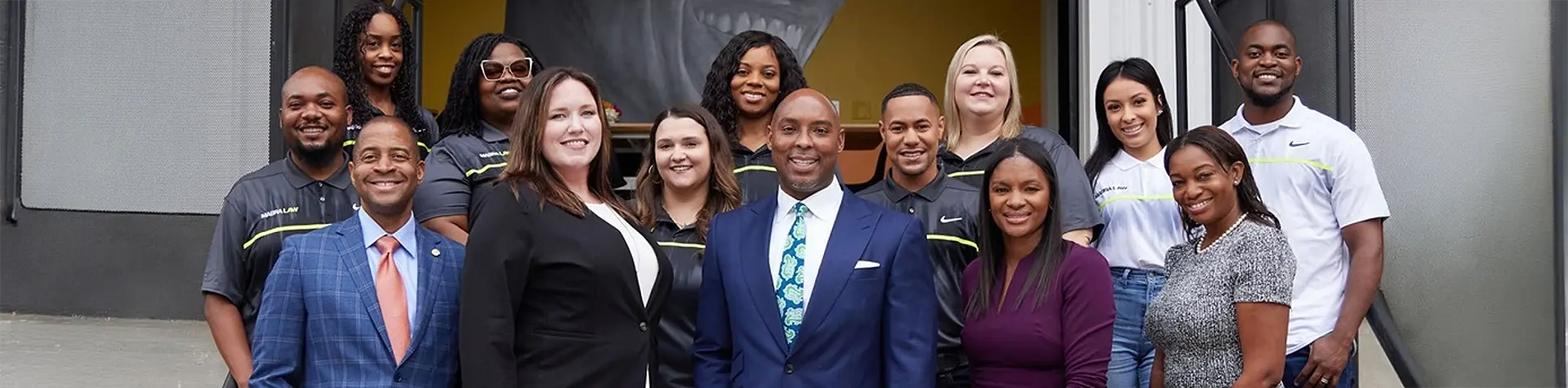
Our firm can evaluate the offer you receive and help you understand if it is fair. We also can negotiate on your behalf to secure better terms. The decision to settle your case is yours, but we are ready to provide you with all the information you need. If and when the time comes when we need to consider taking your case to trial, we will be ready to do that. We are trial lawyers at Mabra Law, and we are well acquainted with what it takes to win in court.
Serving as Your Advocate
Repeatedly having to describe the accident, providing details and reliving an unpleasant event is a common, frustrating outcome after being involved in a crash. In most distracted driving cases, the other driver’s insurance company will quickly reach out to you. It is not uncommon for insurance adjusters to misunderstand or report driver’s statements out of context. In some situations, this could impact your settlement offer.
You also may hear from the other driver’s lawyer or a lawyer from their insurance company. They represent the other driver. Your own insurance carrier also will want information about your claim, and even they may not thoroughly consider your needs. Your attorney will serve as your advocate and the primary point of contact. And, your attorney will deal with the insurance companies so that you don’t have to.
Hiring a lawyer can alleviate stress throughout the process as well as eliminating the need to tell your story multiple times to different individuals. Your lawyer also can protect you from inadvertently saying or doing something that could jeopardize your recovery.
Quick Tip
Insurance adjusters often contact accident victims within days of a crash, before the full extent of injuries is known. Do not give a recorded statement or accept any offer without first speaking with an attorney.
Filing a Lawsuit
We resolve many cases without filing a lawsuit. However, some circumstances inevitably will require litigation to resolve. If your case requires litigation, your lawyer at Mabra Law will handle every aspect of litigating your case. We file a lawsuit on your behalf, handle the discovery process with opposing counsel, and prepare you for trial. Our team will continue working to get you the result that you deserve.
The Cost of Hiring an Atlanta Distracted Driving Accident Attorney
Mabra Law handles distracted driving cases on a contingency fee basis, which means we only collect a fee if money is recovered for you. Our team retains a portion of anything we collect on your behalf as our fee. We work on your behalf when we accept your case at no upfront cost.
Make The Most of Your Free Consultation
Hiring a lawyer after an accident with a distracted driver is a big decision, and it should be based on more than advertisements on television or park benches. You deserve legal counsel that understands what is at stake, and finding out if you have the right attorney in mind starts with the initial consultation.
At Mabra Law, the initial consultation with our team is always free. Speaking with an attorney about your case at no cost is an invaluable resource that you should take advantage of. During this meeting, you will have the opportunity to learn about the potential value of your case. Our team can also answer any questions you might have about the legal process. We aim to address your concerns so you can feel confident and less burdened as you walk out our doors.
Pro Tip
If the other driver violated Georgia’s Hands-Free Law at the time of your accident, it is strong evidence of negligence and can significantly increase your claim’s value. An attorney can subpoena phone records to confirm exactly how the driver’s device was being used at the moment of impact.
Let Mabra Law Help – Contact an Atlanta Distracted Driving Accident Attorney Immediately
Find Out If You Have a Claim for Compensation – Schedule a Free Consult: 404-344-5255
If you have been injured in a collision with a distracted driver, you deserve justice. Your case is important to us. Contact the team at Mabra Law to evaluate your legal options. Reach out today for a free consultation with a distracted driving accident attorney.

Ronnie Mabra
Frequently Asked Questions About Distracted Driving Claims
Answered by Ronnie Mabra, Atlanta Distracted Driving Accident Attorney
How do you actually prove the other driver was on their phone?
We do not rely on the at-fault driver’s honesty. Mabra Law issues formal spoliation letters and subpoenas cellular carrier records to obtain exact timestamps for call logs, incoming/outgoing text data, and internet packet transmissions matching the precise second of the crash. We also analyze vehicle event data recorders (EDRs) to confirm if the driver failed to brake prior to impact.
Is using a hands-free device legal under Georgia’s Hands-Free Law?
Yes, but with strict limitations. Drivers over 18 may use voice-to-text systems, Bluetooth headsets, or single-touch controls to initiate calls. However, even hands-free phone usage creates cognitive distraction. If a hands-free phone conversation diverts a driver’s focus and causes an accident, they can still be held liable under general negligence standards.
What compensation is available in a distracted driving injury lawsuit?
Victims can recover past and future medical costs, lost wages, loss of earning capacity, property damage, pain and suffering, emotional distress, and reduced quality of life. In severe cases involving egregious violations (such as streaming video while driving at high speeds), punitive damages may also be pursued.
How much does it cost to hire an Atlanta distracted driving attorney?
Mabra Law handles all distracted driving accident cases on a contingency fee basis. There are zero upfront costs or out-of-pocket legal fees. We only collect an attorney fee if we successfully secure a financial recovery for your claim.